+48 85 67 69 800
 Can Logistics Be Sustainable? Five Practical Ways to Reduce CO₂ Emissions
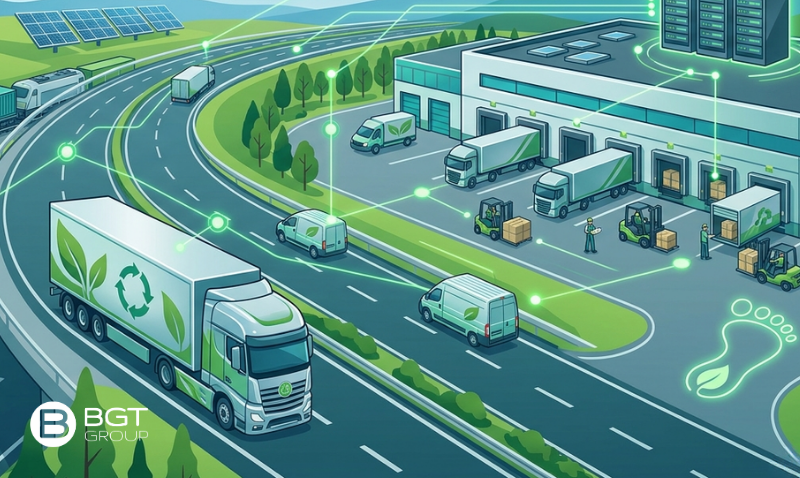
The transport and logistics (TSL) industry accounts for a significant share of greenhouse gas emissions across Europe. At the same time, it offers enormous potential to reduce those emissions—without compromising operational efficiency.
In practice, this means one thing:
A well-planned transport operation can be both more cost-effective and more sustainable.
So, what does that look like in practice?
1. Route Optimisation: The Key to Lower CO₂ Emissions
One of the biggest sources of unnecessary emissions in logistics is empty running—vehicles travelling without a load. Every kilometre driven empty results in:
- unnecessary fuel consumption;
- higher operating costs;
- increased CO₂ emissions.
By optimising transport routes, companies can:
- consolidate shipments into more efficient delivery schedules;
- reduce empty return journeys;
- minimise overall driving distances.
In practice, effective route planning can reduce transport-related emissions by several dozen percent, while simultaneously improving operational efficiency.
2. Cargo Consolidation: Fewer Trips, Greater Efficiency
Not every shipment needs its own dedicated vehicle.
Cargo consolidation combines smaller consignments into a single shipment, resulting in:
- fewer trucks on the road;
- better utilisation of cargo capacity;
- lower transportation costs per shipment.
From both an environmental and economic perspective, cargo consolidation is one of the simplest and most effective strategies for creating a more sustainable supply chain.
3. A Modern Fleet: How Technology Reduces Environmental Impact
The difference in emissions between older commercial vehicles and modern trucks is substantial.
A fleet that meets the Euro 6 emissions standard offers significant advantages:
- lower emissions of harmful pollutants;
- reduced fuel consumption;
- greater operational reliability and predictability.
In addition, transport companies are increasingly implementing:
- driver behaviour monitoring systems;
- fuel-efficiency technologies;
- automated fleet management solutions.
These innovations reduce both environmental impact and operating costs, creating measurable business value.
4. Transshipment Terminals: Shorter Routes, Smaller Carbon Footprint
One of the most overlooked contributors to sustainable logistics is efficient infrastructure.
A strategically located transshipment terminal makes it possible to:
- reduce long-haul transport distances;
- transfer cargo closer to its final destination;
- deploy the most suitable transport mode for each stage of the journey.
Our experience shows that effectively using a transshipment terminal can significantly reduce the number of long-distance heavy truck movements.
The result is a measurable reduction in CO₂ emissions alongside improved operational efficiency.
5. Digital Documentation: Small Change, Big Impact
Sustainable logistics extends beyond transportation itself—it also includes administrative processes.
Digital documentation helps companies:
- reduce paper consumption;
- accelerate information exchange;
- minimise the risk of administrative errors.
Across an entire organisation, these improvements translate into meaningful savings in both time and resources while supporting a more sustainable business model.
Sustainable Logistics Is No Longer a Trend—It Is the New Standard
Just a few years ago, environmentally responsible transport was often viewed primarily as a branding initiative.
Today, it has become an industry standard—and an increasingly important expectation among customers.
Companies that invest in:
- transport optimisation;
- cargo consolidation;
- modern vehicle fleets;
- efficient logistics infrastructure;
not only reduce their CO₂ emissions, but also:
- lower operating costs;
- improve supply chain reliability and predictability;
- build a lasting competitive advantage.
Conclusion: Sustainable Logistics Is Already Here
The examples above demonstrate that the question is no longer whether logistics can be sustainable, but how companies choose to make sustainability part of their long-term strategy.
For the transport and logistics industry, sustainable operations represent a true win-win: the environment benefits from lower greenhouse gas emissions, while businesses gain measurable savings in fuel, time, and operational resources.
By investing in route optimisation, cargo consolidation, and modern technologies, logistics providers are laying the foundation for resilient, efficient, and future-ready operations. At a time of growing environmental responsibility and evolving regulations, sustainable logistics has become one of the most effective ways to achieve long-term competitive advantage.
Would you like to learn how we can optimise your transport operations while reducing costs and emissions? Contact our team—we'll be happy to help.


Why companies entrust us


One operator instead
of several subcontractors

Predictable
delivery times

Managing
difficult routes

Control of the
entire chain

Regular
deliveries
corporate
clients
international
transport per year
professionals
in the team
technical units
for loading
million euros
of annual turnover
Other news